If you own or operate a retail store, restaurant, office, or other commercial space in South Florida, your storefront glass does more than enclose the building — it is your most important marketing tool. The right storefront glass invites customers in, showcases your products, defines your brand’s aesthetic, and protects your business 24/7. Here is a complete guide to storefront glass for South Florida business owners in 2026.
Why Storefront Glass Matters More in South Florida
South Florida storefronts face challenges that don’t exist in most of the country — hurricane-force winds, intense UV exposure, salt air corrosion in coastal areas, and the heat and humidity that comes with the climate. At the same time, South Florida’s outdoor-oriented lifestyle and walkable retail corridors mean storefronts have to look pristine, perform well, and attract foot traffic in ways that interior shopping mall stores don’t have to consider. The right storefront glass meets all these challenges — protecting your business while enhancing its appeal to customers.
Florida Building Code Requirements for Storefront Glass
Every commercial storefront in Miami-Dade and Broward County falls within Florida’s High Velocity Hurricane Zone (HVHZ), which requires specific impact-resistance standards for any glazing exposed to weather. Storefront glass must use either laminated impact-rated glass with proper Florida Product Approval (FPA) documentation, or be protected by a Miami-Dade County NOA-approved hurricane shutter system. New construction and major renovations are not permitted to use non-impact glass without approved protection — this is the law, not a recommendation.
Common Types of Storefront Glass Systems
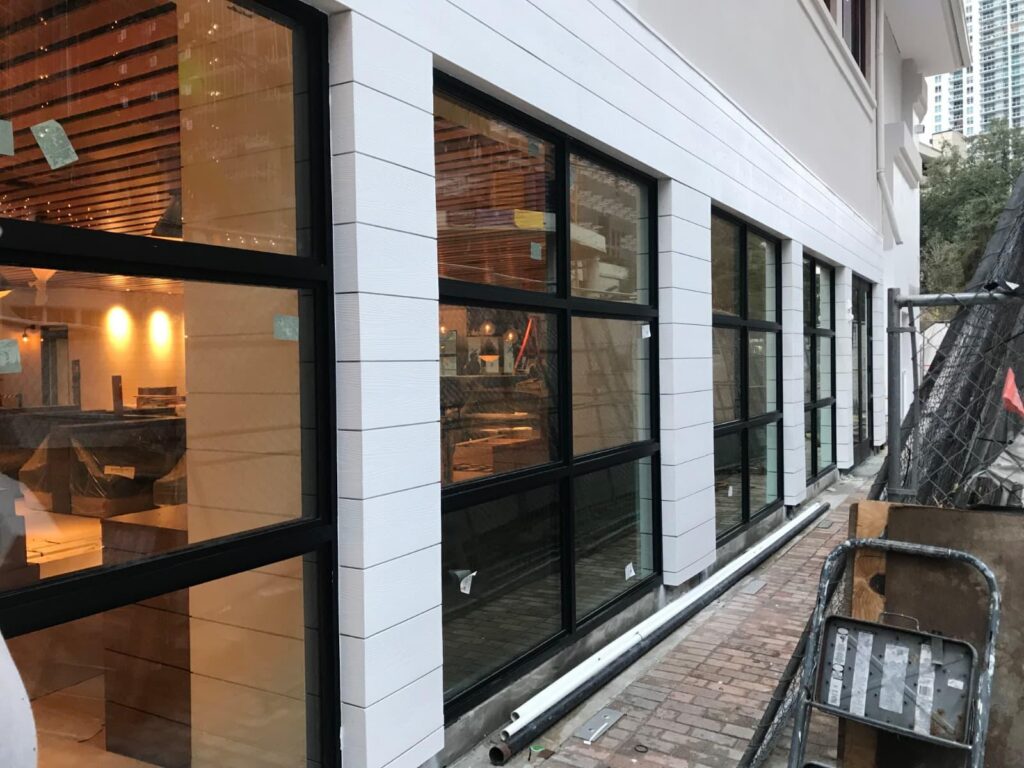
Framed Aluminum Storefront Systems
The most common commercial storefront in South Florida — extruded aluminum frames hold tempered or laminated glass panels in place, with options for clear anodized, dark bronze, or custom-painted finishes. Cost-effective, durable, and available in heights up to 14 feet with proper engineering. Framed systems are the standard for retail strip centers, professional office buildings, and most ground-floor commercial spaces.
Frameless Glass Storefronts
For luxury retail, high-end restaurants, and design-conscious commercial spaces, frameless glass storefronts use thick structural laminated tempered glass (typically 1/2″ or 5/8″) with minimal hardware, creating a near-invisible barrier between interior and exterior. The most premium option — and the most expensive, but worth it for businesses where brand aesthetic matters.
Sliding and Folding Glass Walls
South Florida’s climate is ideal for indoor-outdoor commercial spaces. Sliding glass walls and accordion-folding glass systems let restaurants, cafes, and showrooms open entire facades on beautiful days while still meeting hurricane code when closed. Increasingly popular in Wynwood, Lincoln Road, Las Olas, and Atlantic Avenue commercial corridors.
Curtain Wall Systems
For multi-story commercial buildings, curtain wall systems use aluminum framing and glass to create complete glass facades that span multiple floors. Engineering-intensive but visually striking — common in modern office buildings and hospitality properties.
Storefront Glass Costs in South Florida (2026)
Standard framed aluminum storefront with impact glass: $75 to $150 per square foot installed
Frameless impact glass storefront: $200 to $400 per square foot installed
Sliding glass walls (impact-rated): $400 to $900 per linear foot installed
Accordion-folding glass walls (impact-rated): $700 to $1,400 per linear foot installed
Total project cost depends on system type, glass specifications, hardware finishes, opening sizes, and installation complexity. IG Glass provides detailed written quotes for every commercial project.
Glass Options Beyond Standard Clear
Modern storefronts use much more than basic clear glass. Popular options include:
• Tinted glass (gray, bronze, blue, green) — reduces solar heat gain and adds aesthetic warmth
• Low-E coatings — invisible coatings that block UV and infrared heat while passing visible light, reducing AC costs significantly
• Reflective glass — provides one-way privacy during daytime while maintaining visibility from inside
• Frosted and acid-etched glass — for privacy screens, signage areas, and design accents
• Switchable smart glass — electrically tunable from clear to opaque, used in luxury retail and offices
Hurricane Shutters vs. Impact Glass Storefronts
Some business owners ask whether they should use impact-rated glass or non-impact glass with hurricane shutters. Both are code-compliant approaches, but they have very different implications. Impact glass costs more upfront but offers continuous protection without any action required — critical when storms develop quickly or when the business is closed. Hurricane shutters cost less upfront but require deployment before each storm, can be unsightly when deployed, and provide no security benefit between storms. For most modern South Florida commercial properties, impact glass is the better long-term investment.
Permits and Installation Timelines
Every commercial storefront installation in Miami-Dade and Broward County requires a permit. Timelines typically run 4 to 8 weeks for permit review on standard storefront projects, plus 2 to 6 weeks for fabrication and 1 to 2 weeks for installation. Total project timeline from quote to completion typically runs 8 to 16 weeks. IG Glass handles all permitting through the local building department as part of every commercial installation.
Schedule a Free Commercial Storefront Consultation
IG Glass designs and installs commercial storefront glass systems throughout Miami-Dade and Broward County. From small retail boutiques to large commercial facades, we handle design, permitting, fabrication, and installation in-house. Call (786) 312-8778 or request a free quote online.