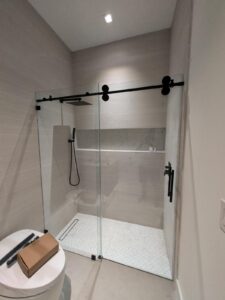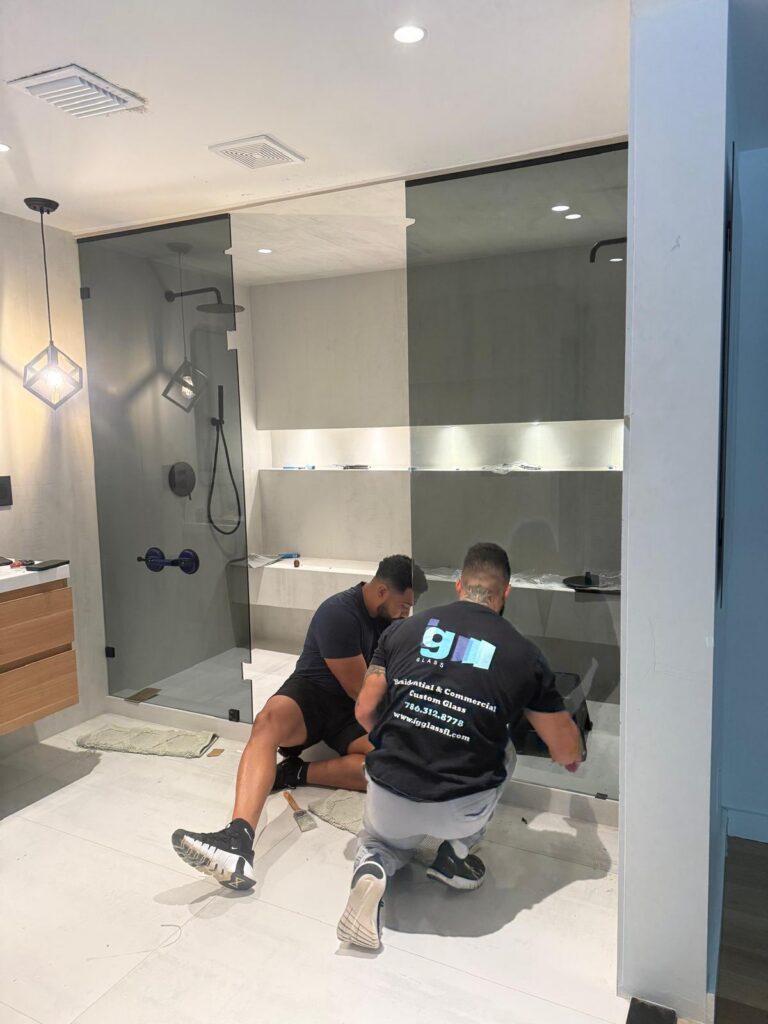
A steam shower turns a bathroom into a spa — and turns an ordinary shower enclosure into the wrong tool for the job. Standard frameless enclosures are designed to let air move; steam showers are designed to trap it. That single difference changes the glass, the hardware, the height, and the details. Here is what South Florida homeowners planning a steam shower need to know before the glass is ordered.
The Core Difference: Sealed vs. Ventilated
An ordinary frameless shower has gaps by design: an open top, a space under the door, small clearances at hinges. Steam escapes through every one of them, wasting the generator’s output and fogging the bathroom. A steam enclosure runs floor to ceiling (or to a solid header), with gasketed seals on every edge and a door that closes against a full perimeter. The room stays dry; the shower fills with steam in minutes.
The Transom: The Detail Everyone Forgets
Sealed enclosures need a way to let steam out when you are done and to keep a bit of air moving between sessions. The answer is an operable transom — a hinged glass panel above the door that opens for ventilation and closes for steam. Getting the transom sized, hinged, and sealed properly is the signature skill of steam glasswork; enclosures without one become mildew factories.
Glass Specification
Steam enclosures use tempered glass, typically 3/8” for stability across the taller, fully enclosed panels, with edges finished for gasket contact. Low-iron glass keeps the look crisp under steam-room lighting. A protective coating earns its keep here more than anywhere: condensation on every session means mineral spotting on every session without it.
The Ceiling Matters
Steam rises and condenses; a flat ceiling drips on you. Steam rooms use sloped ceilings (roughly two inches per foot) so condensation runs to the walls, and ceiling height is kept modest — excess cubic volume needs a bigger generator. Your contractor and your glass installer should coordinate the ceiling detail with the enclosure header so the glass meets a finished, waterproofed surface.
Waterproofing and Materials Around the Glass
Everything inside a steam shower gets wet, including surfaces normal showers never see. Vapor barriers behind tile, fully waterproofed benches and ceilings, and non-porous finishes are standard — natural stone requires sealing and maintenance. The glass installation follows waterproofing and tile; measuring happens on finished surfaces so the sealed perimeter is truly sealed.
Hardware and Seals
Steam-rated hinges, polycarbonate or vinyl seals on all edges, a door sweep that actually seals, and a handle that does not become a conductor of heat. Continuous hinges or heavy-duty pivot systems are common on taller doors. This is the kind of enclosure where a generic online kit fails first and fails expensively.
Planning a Steam Shower?
IG Glass designs and installs sealed steam shower enclosures with operable transoms across Miami-Dade and Broward, coordinated with your contractor’s waterproofing and generator plan. Contact us or call 786-312-8778 to talk through your steam room before the tile goes on.