Small bathrooms are a fact of life in South Florida, from Art Deco condos in Miami Beach to mid-century homes in Hollywood and compact guest baths everywhere in between. But a small footprint does not have to feel cramped. The single most effective upgrade for making a modest bathroom feel dramatically larger is replacing a shower curtain or framed enclosure with frameless glass. Here is why it works, and the design tricks that get the most out of every square foot.
Why Glass Makes Small Bathrooms Feel Bigger
A shower curtain or framed opaque door cuts your bathroom in two. Your eye stops at the barrier, and the room reads as everything in front of it. Remove that visual wall and the bathroom instantly reads as its full dimensions: light travels to the back wall, tile work stays visible, and the shower becomes part of the room instead of a box inside it. Designers call this borrowed space, and in a 5×8 bathroom it can change the entire feel of the room.
Seven Design Tricks for Small-Bathroom Showers
1. Go frameless, not semi-frameless
Every piece of metal framing adds a visual line that shrinks the space. Fully frameless enclosures use minimal hardware, small hinges, clips, and a discreet handle, so the glass all but disappears.
2. Choose low-iron glass
Standard clear glass has a faint green tint that deepens with thickness. Low-iron glass is truly colorless, which keeps whites white and lets your tile color come through exactly as intended. In a small room where the shower wall is the main design feature, it is a worthwhile upgrade.
3. Skip the door entirely where layout allows
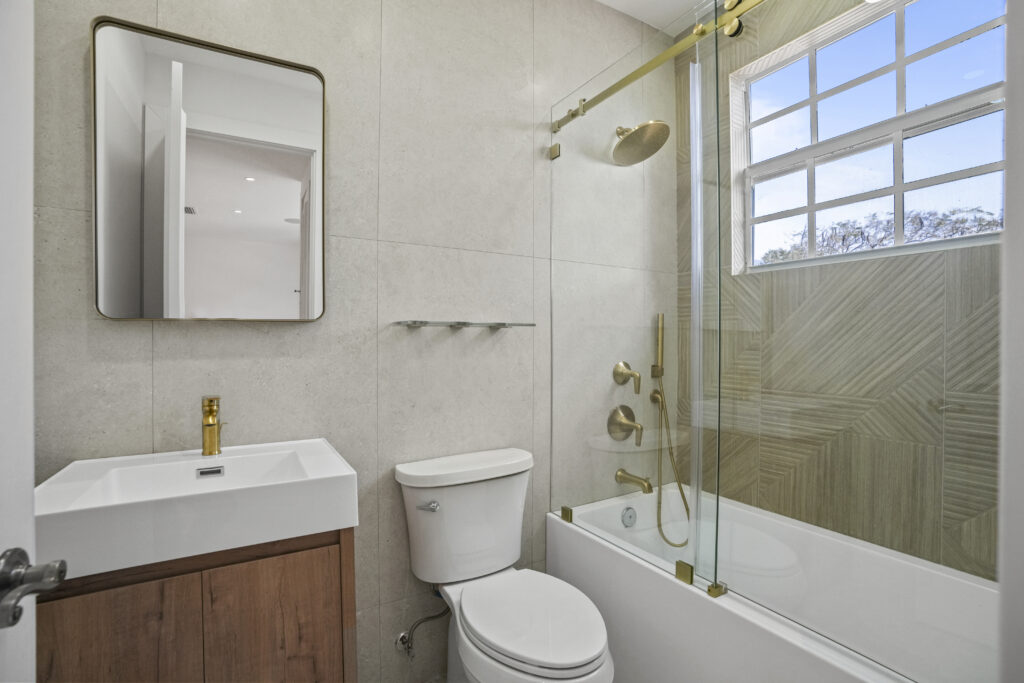
A single fixed panel with an open entry, often called a walk-in or wet-room style, eliminates door swing from the equation entirely. If your shower opening is wide enough, one panel of glass shielding the spray zone is the cleanest look a small bathroom can have.
4. Use a sliding system when swing space is tight
Hinged doors need clearance, and in small bathrooms the door can conflict with the vanity or toilet. Modern frameless sliding systems solve this with full-width access and zero swing radius.
5. Run tile floor-to-ceiling and keep the glass tall
Taller glass draws the eye up. Pairing a ceiling-height enclosure with vertical tile makes an eight-foot ceiling feel higher and the whole room feel more intentional.
6. Match the curb or go curbless
A low-profile curb, or better yet a curbless entry with a linear drain, keeps the floor plane continuous. When the same floor tile runs into the shower uninterrupted, the room reads as one space.
7. Keep hardware minimal and consistent
Pick one finish, matte black, brushed nickel, chrome, or brushed gold, and match your shower hardware, faucet, and towel bars. In a small room, consistency reads as calm; mixed finishes read as clutter.
What About Privacy?
Clear glass is not the only option. Frosted, satin-etched, and textured glass all provide privacy while still transmitting light, a far better outcome than an opaque curtain. Another popular compromise is a partial-frost design: clear glass with a frosted band at body height.
Cleaning Concerns, Answered
The number one hesitation we hear about glass in small bathrooms is cleaning. Two things solve it: a factory-applied hydrophobic coating that makes water sheet off instead of spotting, and a 20-second squeegee habit after showering. Compared to washing a mildewed curtain, most homeowners find glass easier to live with, not harder.
Ready to Open Up Your Bathroom?
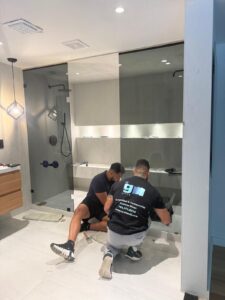
IG Glass designs, fabricates, and installs custom frameless shower enclosures across Miami-Dade and Broward, measured to the millimeter for openings of every size, including the tricky small ones. Contact us or call 786-312-8778 for a free consultation.