Some of the most useful glass in a home never gets a headline: the protective top on a dining table, the floating shelves in a shower niche, the cover on an antique desk, the glass that turns a stone base into a table at all. Custom-cut furniture glass is a quiet specialty — and getting thickness, edge, and glass type right is the difference between a piece that looks built-in and one that looks like an afterthought. Here is the guide.
Tabletops: Protective Covers vs. Structural Tops
A protective cover sits on an existing wood or stone surface to shield it from spills, heat, and scratches; a structural top spans a base — pedestal, trestle, metal frame — and is the table. They call for different glass: protective covers are typically 1/4”, cut to the shape of the piece with a soft edge; structural tops are 3/8” to 3/4”, tempered, and sized for the span between supports. The unsupported distance determines thickness — a large dining top on a single pedestal needs substantially heavier glass than a coffee table on four legs.
Edges: The Detail You Touch Every Day
Edgework defines how furniture glass feels and looks. Flat polished edges are clean and modern; pencil (rounded) edges are soft and family-friendly; beveled edges add a traditional, prismatic frame; and ogee or other profiled edges suit formal pieces. Corners can be squared, eased, or radiused — radiused corners are the sensible choice anywhere children and hips pass by.
Glass Types
Clear glass shows a faint green tint at thicker sizes; low-iron glass reads truly colorless — worth it over light wood or white stone. Tempered glass is standard for structural tops and any piece that could take an impact; annealed is fine for light protective covers. Back-painted and frosted options turn a top into a design element, and tinted bronze or gray glass suits certain furniture styles beautifully.
Shelves: Where Glass Shines
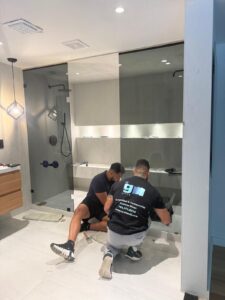
Glass shelving disappears visually and lets light through — the reason it dominates in showers, bathrooms, display niches, and wet bars. Shower niche shelves in tempered low-iron glass with polished edges are a small upgrade with outsized effect. Wall-mounted display shelves depend on bracket spacing and load: thicker glass and closer brackets for books and heavy objects, lighter for décor. Our team calculates spans so shelves stay flat and safe.
Protecting the Furniture Under the Glass
Glass covers on wood need clear bumpers between the surfaces — they lift the glass slightly, prevent moisture trapping and sticking, and stop the top from sliding. On antiques or finished wood, avoid sealing a full-contact cover; the small air gap protects the finish. Templating matters for irregular shapes: we trace the piece for a cut that follows every curve.
Ordering Custom Furniture Glass
Bring dimensions or the piece’s shape, tell us how it is supported and how it will be used, and choose thickness, edge, and glass type with us. Most pieces are cut and finished within days. Contact us or call 786-312-8778 — IG Glass fabricates custom tabletops, shelves, and furniture glass across Miami-Dade and Broward.